Platform for Social Development
and Innovation
More than 70 civil society organisations call for the annulment of the decision not to require an environmental impact assessment for the Belgrade Aquarium
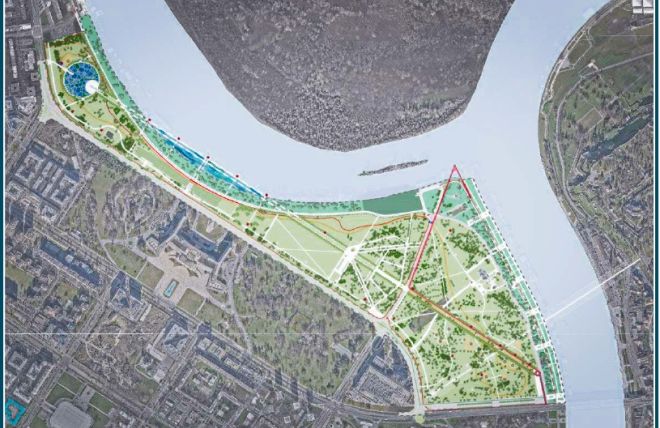
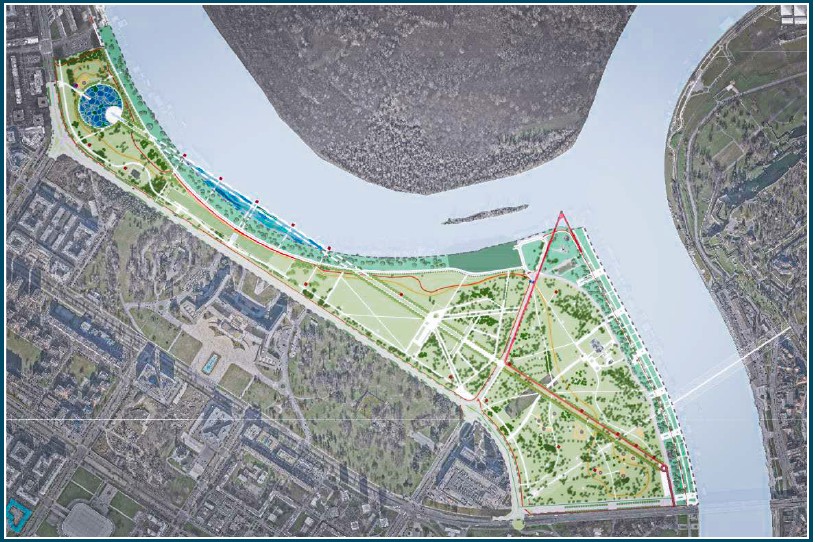
Photo: Urban Planning Institute of Belgrade, urban design project for Ušće Park
Friendship Park is not vacant land waiting to be put to use. It is one of Belgrade’s most valuable public green spaces, an integral part of the city’s identity and a key element of its resilience to climate change. More than 70 civil society organisations warn that the decision by the City of Belgrade’s Secretariat for Environmental Protection not to require an environmental impact assessment for the proposed Belgrade Aquarium is contrary to the public interest.
An environmental impact assessment is the last available mechanism for comprehensively assessing and preventing potential adverse impacts of this project on the environment and Belgrade’s residents. If a construction permit is issued without a prior environmental impact assessment study and public participation in the assessment process, both the environment and the people who live in Belgrade will bear the consequences.
The planned construction of the aquarium in Friendship Park is about more than a single building. It raises a broader question about how Belgrade values its most valuable public green spaces, its urban ecosystem and its residents’ quality of life. The area is at once a drinking water source protection zone, a designated cultural heritage site, a public park and a core part of the city’s green infrastructure network. It is also closely connected to the ecologically significant confluence of the Sava and Danube rivers and ecological corridors of international importance.
This area helps protect Belgrade’s drinking water supplies, improves air quality, moderates local temperatures, supports a wide range of plant and animal species, and provides space for recreation, social interaction and cultural life.
The planned development in Friendship Park will affect all of this. To what extent? The public cannot know, because the Secretariat has decided that an environmental impact assessment is not required.
In determining whether an environmental impact assessment was necessary, the Secretariat failed to adequately consider the cumulative impacts of the aquarium and other planned developments in Friendship Park and the Ušće area. A mixed-use residential and commercial complex comprising several buildings, including two towers more than 150 metres tall, is planned for the site of the demolished Hotel Jugoslavija. Construction of the Natural History Museum, the Museum of 21st-Century Art and associated infrastructure is also planned on neighbouring plots.
For this reason, it is not sufficient to assess the aquarium as an isolated development. The combined effects of these developments on life in the city must be assessed, including impacts on urban temperatures, the risk of flooding from heavy rainfall, air quality, water quality in the Danube, habitats for birds and other wildlife on Great War Island, and cultural heritage.
The planned transplanting of trees make way for the aquarium does not guarantee their survival. Transplanting mature trees is a complex procedure that requires preparation for one to three growing seasons. Given that the trees in Friendship Park have not undergone such preparation and transplantation is planned for the summer, there is a high risk that the transplanted trees will not survive.
We call on the competent authorities to give due consideration to these arguments in the appeal proceedings, annul the contested decision and ensure that an environmental impact assessment is carried out for the Belgrade Aquarium project.
Organisations endorsing the statement: